





In 2014, thousands of Ukrainians faced a choice no one should ever have to make: stay at home and risk their lives, or gather their most essential belongings and leave for an uncertain future. According to estimates by international organisations, the number of people forced to flee their homes because of the conflict in Ukraine rose sharply throughout 2014.
No one had planned to become displaced. No one had prepared their children for sleeping in someone else’s room instead of their own beds, finding a new school instead of attending the one they knew, or having to think about where to spend the next night instead of simply returning home after work.
People packed documents, medicines, children’s clothes and photographs into their suitcases. Often, they took only what they could fit in a few minutes. Everything else was left behind: flats, houses, jobs, personal belongings, family archives and the lives they had known. Above all, they left behind the certainty that tomorrow would be just like yesterday.
First, residents of occupied Crimea began leaving their homes. Later, people from Donetsk and Luhansk regions followed as hostilities spread. The geographical reach of forced displacement expanded alongside the geography of the war. In September 2014, UNHCR reported a further increase in the number of internally displaced persons (IDPs) in Ukraine.
Most people did not see their departure as permanent. They believed it would only be temporary: a few weeks, a month, perhaps until autumn. They went to stay with relatives and friends, sought accommodation in sanatoriums and student dormitories, and looked for any place that could offer shelter. Many even left essential belongings behind, convinced they would soon return.
But for many, that return never happened.
2014 marked the beginning of mass internal displacement in Ukraine. It was not a single evacuation or an event that took place on one particular day. It was thousands of individual stories of forced departure that gradually developed into a major humanitarian crisis. The state was only beginning to establish support mechanisms, volunteers were searching for transport and accommodation, and people themselves were trying to understand how to rebuild their lives from scratch. The scale of displacement and the humanitarian needs of affected people in 2014 were documented in UNHCR reports and the PACE report on the humanitarian situation of Ukrainian refugees and displaced persons.
To understand how Ukraine faced this challenge, we need to return to the first months of 2014.
March–April 2014: The Occupation of Crimea and the First Waves of Forced Displacement
The forced displacement of people in Ukraine began even before active hostilities broke out in Donbas. The first to be forced to leave their homes were residents of the Crimean Peninsula, following its occupation by the Russian Federation in February–March 2014. A timeline of events and an assessment of the situation in Ukraine during this period are provided in a report by the OSCE Office for Democratic Institutions and Human Rights (ODIHR).
On 26 February 2014, mass rallies in support of Ukraine’s territorial integrity took place outside the building of the Supreme Council of the Autonomous Republic of Crimea.
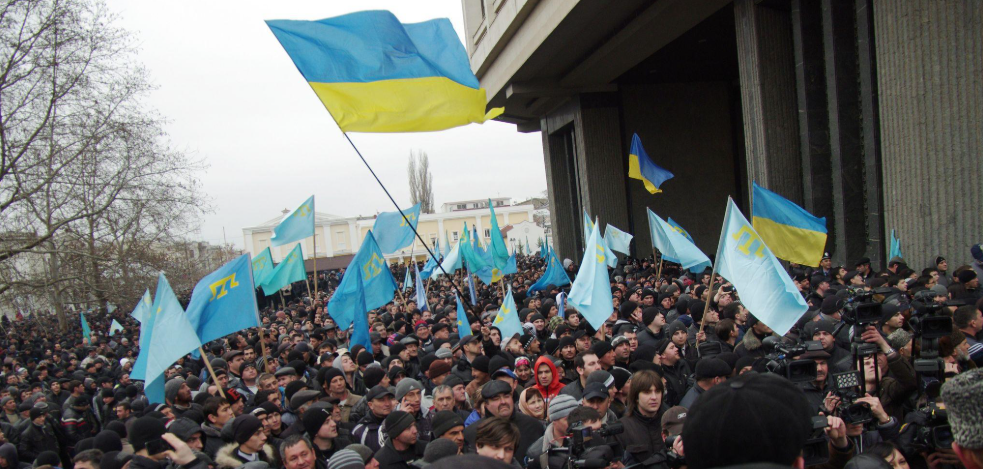 Photo by Voice of America. Crimea, 2 March 2014
The following day, armed men seized the buildings of the Crimean parliament and government. Russian military personnel subsequently established control over strategic facilities across the peninsula. These events and their context are described in detail in the OSCE/ODIHR report.
On 16 March, a so-called referendum was held in Crimea. Neither Ukraine nor the international community recognised it. On 18 March, Russia announced that it was incorporating Crimea into the Russian Federation. The PACE report provides an assessment of these events and their consequences.
The change in effective control over the peninsula was accompanied by the persecution of people who opposed the occupation or openly supported Ukraine. Pro-Ukrainian activists, journalists, human rights defenders, members of the Crimean Tatar community and Ukrainian military personnel were among those at risk. These violations were documented, among other sources, in the Office of the United Nations High Commissioner for Human Rights’ report on the human rights situation in Ukraine, dated 15 May 2014.
The first documented cases of enforced disappearances in Crimea date back to March 2014. According to the UN Human Rights Monitoring Mission in Ukraine, 43 cases of enforced disappearance were documented between the beginning of the occupation and May 2018. Those affected included pro-Ukrainian activists and members of the Crimean Tatar community.
These events were among the factors that forced residents to leave the peninsula. The situation was particularly difficult for Crimean Tatars who openly opposed the occupation, supported Ukraine’s territorial integrity and refused to recognise the illegal change in Crimea’s status. Community representatives reported threats, persecution, searches and pressure on civic and religious organisations. Human rights violations in Crimea following the establishment of Russian control were also documented in UN reports.
Ukrainian journalists, civic activists, human rights defenders, members of religious communities and professionals who refused to work under the new rules imposed by the occupation authorities also left the peninsula. The PACE report on the humanitarian situation of Ukrainian refugees and displaced persons describes the reasons for their departure, including fears for their personal safety, threats and persecution on the grounds of ethnicity, religious beliefs or human rights work.
According to statistics from the Office of the United Nations High Commissioner for Refugees (UNHCR), cited in the report, 17,928 people had left Crimea by 24 September 2014. This included 5,068 children and 1,269 older people and persons with disabilities. The source of these statistics is the PACE report, which cites UNHCR data.
Almost half of the internally displaced persons from Crimea relocated to central regions of Ukraine, while around a quarter moved to the western regions. Some were accommodated in sanatoriums, hotels, temporary shelters or private homes.
Thus, the first wave of internal displacement was driven not only by the occupation of territory but also by systematic human rights violations, persecution and threats to the personal safety of Crimea’s residents.
However, forced displacement was not confined to Crimea. By spring 2014, it was already beginning to reach a much greater scale. Armed confrontation was unfolding in eastern Ukraine, and residents of Donetsk and Luhansk regions increasingly faced the threat of losing their homes, their familiar way of life and their safety. The war was forcing ever more people to leave their homes.
April–Summer 2014: The East in Flames and Maps Torn Apart
In April 2014, the armed conflict spread to Donetsk and Luhansk regions. Radio Free Europe/Radio Liberty (RFE/RL) reported on the events that day. The seizure of administrative buildings, the emergence of illegal armed groups, armed clashes and the gradual loss of Ukrainian government control over parts of the territory significantly altered the security situation in the region.
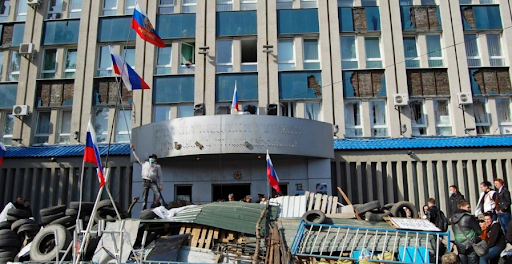
Photo: Radio Free Europe/Radio Liberty (RFE/RL). Luhansk, April 2014.
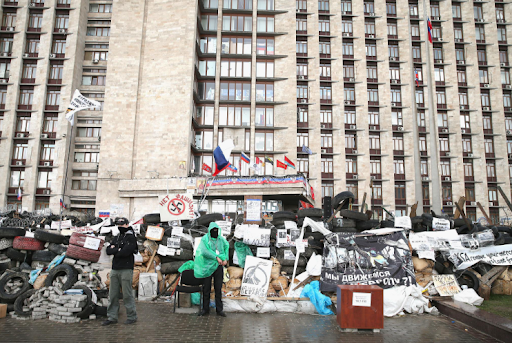
UNIAN Photos — Seizure of the Donetsk Regional State Administration (RSA)
The first people to leave were those directly caught up in the fighting or facing threats because of their civic stance, professional activities or cooperation with Ukrainian state institutions. They included local councillors, civil servants, journalists, civic activists, human rights defenders and members of the security forces.
Over time, the geographical scope of displacement expanded significantly. Families with children, older people, persons with disabilities, students and business owners also began to leave. For many, the decision to abandon their homes was a forced response to shelling, damage to residential buildings, disruptions to water and electricity supplies, and the closure of public institutions and businesses.
The situation was particularly difficult in settlements at the epicentre of the fighting. People did not always have an opportunity to prepare for their departure in advance: transport links were disrupted, railway routes were changed, and travelling by car involved considerable risks.
Kharkiv, Dnipropetrovsk and Zaporizhzhia regions, as well as Kyiv, became some of the first destinations for evacuation and independent departures. Some people remained in neighbouring regions, hoping to return home once the hostilities ended. Others went to stay with relatives or sought temporary accommodation through volunteer initiatives. The Rinat Akhmetov Foundation, among others, reported on the organisation of evacuations from towns in Donetsk region and the subsequent accommodation of evacuees.
Importantly, at this stage, displacement was largely self-organised. People found their own transport, arranged accommodation and turned to friends and volunteers for help. Systematic state support was still being developed, while the mechanisms for registering and keeping records of displaced people did not meet the scale of their needs. One example of an organised evacuation involving the state was a train carrying 163 people from towns in Donetsk region, which arrived in Kyiv on 17 June 2014.
Sofia’s story: From a graduation ceremony under armed supervision to her first university lecture in Kyiv
Before the hostilities began, Sofia lived in Khartsyzk, a town about half an hour’s drive from Donetsk. At the time, her life followed the familiar rhythm of a school-leaver’s final year: school, friends, preparing for exams and university admission. She was in the last Ukrainian-language class at her school and had no idea how soon her familiar world would change.
The first signs of trouble emerged gradually. Disagreements over political views became increasingly common at school, even among teachers. After the seizure of the Donetsk Regional State Administration building and the proclamation of the so-called “Donetsk People’s Republic” (“DPR”), these discussions no longer seemed distant or abstract. Sofia recalls that one of the most painful realisations was that people close to her, including her best friend and her family, supported an entirely different position.
But the moment when the danger became unmistakably real came in late May 2014, during her graduation ceremony. After celebrating at a restaurant, the students had planned to go to a park, set off fireworks and watch the sunrise. However, that evening, armed men in military uniforms arrived at the venue and warned the parents of the consequences if the young people went outside at night. The celebration had to continue with everyone effectively confined inside the restaurant. In the morning, each graduate was taken home.
Another class, which was celebrating that evening by a local lake, ignored the warnings. A burst of automatic gunfire rang out over the students’ heads. After that, there was no longer any doubt: the town was no longer safe.
Sofia did not make the decision to leave on her own. She was only 17, and her parents made the decision for her. Due to difficult family and financial circumstances, the whole family could not leave together, so they decided that Sofia would go first. She headed to Kyiv, where she enrolled at a university.
However, the journey towards her new life proved far more difficult than expected. In August, when Sofia travelled with her mother to submit her university application documents, the train to Kyiv was overcrowded with people leaving Donetsk region. On the return journey, however, they found themselves in an almost empty carriage: there were only ten passengers on the entire Kyiv–Donetsk train. The train did not reach Makiivka, their intended destination, and was stopped in Yasynuvata. At the station, Sofia and her mother looked closely at the soldiers’ insignia, trying to work out who controlled the town. They were members of the illegal armed groups of the so-called “DPR”.
Their plan to leave earlier fell through. On 17 August, Khartsyzk came under shelling. One of the shells struck the home of Sofia’s classmate. The girl and her sister were seriously injured, and the house burned down. After that, the family remained at home for another two weeks, sheltering alternately in the basement and in a corridor where several walls separated them from the street.
Meanwhile, the town was becoming increasingly cut off from everyday life. Railway services had stopped, bus tickets were unavailable, and gas and electricity supplies were being cut off. People cooked over open fires. Sofia’s family was fortunate enough to have electricity, so they even shared the food they cooked with neighbours and acquaintances.
But time was running out. The university was holding Sofia’s place only until 10 September, after which she risked losing her admission. An opportunity to leave arose after a brief lull in the fighting in late August. On 1 September, Sofia and her mother set off. First, they took a private carrier’s bus that happened to be available to Donetsk, then travelled towards Sloviansk. The buses used dirt tracks and rural roads, often travelling in pairs or convoys, as this was considered safer. In Sloviansk, they transferred to a train to Kyiv.
By 2 September, Sofia was already in the capital. The following day, she was sitting in her first university lecture.
She took only the essentials with her, but had to pack clothes for every season because she did not know how long she would be away or when she might be able to return. She had to leave many things behind, including her cat, Luna, whom she still misses.
Starting a new life in Kyiv was not easy either. When Sofia went to register at the student dormitory, she heard the administration say: “We don’t accommodate people from Donetsk.” She was eventually given a room, but the experience left another painful mark. At 17, she found herself in an unfamiliar city, without family, friends or anyone she knew. The first six months were so difficult that she cried almost every day.
Over time, Sofia adapted, but the hope of returning home remained for a long time. For almost six years after moving, she continued to visit from time to time. Every journey was exhausting: document and phone checks at checkpoints, interrogations, walks of several kilometres between checkpoints and long waits for transport. With each passing year, returning became increasingly painful as she saw how her home region was changing.
The last time Sofia was home was on 17 January 2020. Her whole family – her mother, father, brother and Sofia herself – stood together at the bus station. They took one final family photograph.
Behind the overall figures on forced displacement were individual human stories. In July 2014, Human Rights Watch published testimonies from displaced people from Kramatorsk, describing the circumstances of their departure. Anna, aged 27, left the town on 15 June with her six-year-old child. Because the bus was overcrowded, the family had to leave some of their belongings behind. She had very little money and did not know where they would be able to stay. Another Kramatorsk resident, Svitlana, left with her two young children. Due to the fighting, an ambulance could not reach her; documents were checked at checkpoints, and there were no tickets available at Donetsk railway station. Eventually, with the help of volunteers, the family managed to reach Lviv. Human Rights Watch published these accounts from displaced people on 21 July 2014.
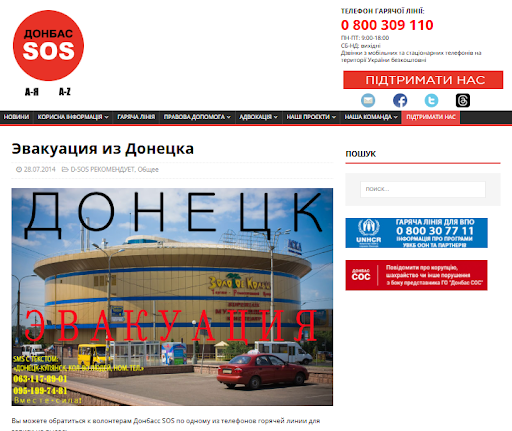
The civil society organisation Donbas SOS also played an important role in supporting people affected by the conflict. We coordinated assistance to those affected, helped people leave dangerous areas and supported them in finding temporary accommodation. According to information published on the organisation’s official website, from the summer of 2014 Donbas SOS coordinated the evacuation of residents from areas where active hostilities were taking place: hotline operators compiled lists of people wishing to leave and passed them on to volunteers on the ground. The organisation’s website also retains an announcement dated 28 July 2014 about an evacuation from Donetsk.
The scale of displacement grew rapidly. According to estimates by the Office of the United Nations High Commissioner for Refugees (UNHCR), as of 5 August 2014, there were more than 117,000 internally displaced persons (IDPs) in Ukraine. Of these, approximately 102,600 had fled Donetsk and Luhansk regions. By comparison, at the beginning of June, the number of people displaced from these regions stood at around 2,600.
According to UNHCR estimates, by 1 September 2014, the number of IDPs in Ukraine had risen to approximately 260,000. By comparison, there had been around 117,000 as of 5 August. This means that in less than a month, the number of people forced to leave their homes had more than doubled. According to UNHCR data published on 2 September 2014.
In late July 2014, Ukrainian forces organised corridors for civilians to leave areas affected by the fighting. According to information in a UN report, as of 30 July, such corridors were operating for people wishing to leave Donetsk, Horlivka and Luhansk. However, even access to these routes did not guarantee safety. The report documented accounts of people being robbed at checkpoints, subjected to persecution, and exposed to shelling while attempting to leave dangerous areas. The report of the UN High Commissioner for Human Rights on the situation in Ukraine, A/HRC/27/75, dated 19 September 2014.
These figures showed that displacement was no longer an isolated phenomenon. Ukraine was facing a large-scale humanitarian crisis that required not only the urgent provision of accommodation but also the development of state mechanisms for registration, social protection and access to essential services.
2014 marked the beginning of a new reality for hundreds of thousands of Ukrainians. What had initially seemed like a temporary departure became prolonged forced displacement for many. People needed not only to find shelter but also to replace lost documents, find work, enrol their children in schools and gain access to healthcare and social services.
Ukraine faced a challenge for which its state system was unprepared. Mechanisms for registering and supporting internally displaced persons gradually began to take shape, while civil society organisations and volunteer initiatives became an essential part of the response.
But behind every figure was an individual human story: a story of a home left behind, a journey into the unknown and an attempt to start life anew.